Saturday, July 21, 2012

Is This Kids Church Coloring Page More Tragic or Funny?


This is an actual children's coloring page my wife found online (she leads children's ministry for our church). It's title: Resisting Temptation.

I'm not sure if it's more tragic or funny. This drawing warns our children of the evil path in life, which includes swimming pools and swing sets. And it encourages them to  live as a true Christian: avoiding fun and attending services at your local church.

Note 1: This children's ministry website has provided many other wonderful coloring pages for us. How this one slipped in, I don't know, but the rest of the site is great.

Note 2: There's no special significance in the "Baptist" title of that church. I've seen this mentality (if not this coloring page) in many, many denominations.

Note 3: Though you probably just laughed at the absurdity of this picture, you may have reinforced this same message with your kids. If you've ever required that your family attend church, no matter how tired you are or busy you've been, because that's what good Christians do--and if in that same week you did nothing else with your faith (talk about the Bible, pray for each other, serve someone less fortunate, worship God together, etc)--then you gave the message that the heart of the Christian life is attending services. You inadvertently passed on the message that despite all our rhetoric on Sunday about making a difference in the world, the fundamental Christian duty is attending services (and if you're very committed, tithing 10% to that church, of course). The other items are icing on the cake.

I'm not against attending services. The Bible does challenge us to "not forsake gathering together" (Hebrews 10:24-25). And I'm not saying that skipping church during a busy week helps your kids. I'm concerned about how our focus on church services has dominated our concept Christian living. We've become comfortable with a Christian life that includes only service attendance.

Hold on, Scott. Better a little something than nothing at all, right? At least we're going to church regularly. Actually, Jesus said to the church in Revelation 3:15-16:

I know your deeds, that you are neither cold nor hot; I wish that you were cold or hot. So because you are lukewarm, and neither hot nor cold, I will spit you out of My mouth.

God would rather you be cold than be comfortable with a passive Christian routine. He might prefer you stop attending altogether and face the fact that your relationship with Him isn't a real priority in your life. He might be disturbed to see you keep coming to church week after week, doing nothing else, and patting yourself on the back.

We find this coloring page funny precisely because it hits close to home. (There's a nugget of truth in every joke that works--that's what makes them funny.)

Is your church inoculating you from real engagement by implying that Sunday services are the primary responsibility you have as a Christian? (Think about what they do as much as what they say from the pulpit.)

If you'd like to learn more about what a totally different approach to Christian living can look like (and it's not about being more busy at more church services or giving more money to missionaries) check out my book at Amazon or email me for a free e-book copy at scott@memberdrivenchurch.com.

Wednesday, July 18, 2012

How Long To Go From Acquaintances To Authentic Community?


Authentic community is the foundation for all the other purposes of the church. The more you know each other--really know each other--the easier and more effective all the other ministries of the church, from teaching to giving to evangelism.

Several aspects of the member-driven church model are designed to build this authentic community. I've posted about some of them previously. But I've not talked about how long it usually takes to build.

It usually takes about six months of sustained effort to really get a strong foundation of real relationships.

That's based on some assumptions:

1. You're meeting weekly. The more often you meet, the faster this goes--the less often, the slower.

2. You don't have any preexisting hostilities or competitions when you begin. If you do, this can take much, much longer. Normal human insecurities are challenging enough.

3. You are doing something to build community every single week. I'm talking about six months of constant community building, not a big event every four to six weeks. Regularity is more important than infrequent events--even if they're grand events.

4. You don't radically change the members of the group, especially having lots of new members join. This isn't an abstract timeline. It takes that long for specific people to build trusting relationships with other, specific people. Change those people and you have start from scratch with the new people.

(Side note: once it's established, it's much easier to graft someone into a strong community. But while you're building it for the first time, new people dramatically slow it down. I'm not saying you should avoid new people, but you do need to know they impact this process.)

5. My experience is only with Americans. It may move faster--or slower--in other cultures. Can anyone with international community building experience share how it works in the other cultures you know?

Remember, this is only a generic prediction. Don't make too big a deal out of it being exactly six months with your group. I just wanted to give you something of a realistic expectation, based on my experience in several different settings for many, many years. It's not a hard, precise rule.

In fact, my final statement trumps everything I've just said: Relationship building is never efficient or predictable.

(More posts on the implications will come later.)

Saturday, July 14, 2012

The 6 Phases To Building Authentic Relationship (& 5 Implications For Your Life)


In general, here's the process, in sequence from 1-6, that people go through in building authentic community:

Share…
  1. Knowledge  about each other
  1. Experiences (do stuff together)
  1. Opinions
  1. Feelings
  1. Failures/Struggles
  1. Successes/Big Wins

FIVE IMPLICATIONS
1. In most cultures (at least the Western cultures I know), the most risky thing to do, drawing the most judgment and displeasure, is to truly share your victories--excitedly and unvarnished with self-deprecating comments. Saying you've messed up is usually more socially acceptable than saying you were awesome. Certain competitive environments, like cutthroat corporations, may have these levels reversed, though. If you think for a moment, you'll know whether failures or successes is more risky in your setting.

2. The process is a progression of adding a new layer without dropping what you've been doing. For example, you keep learning more facts about each other (level 1) while you're doing things together (level 2) that include conversations about opinions (level 3). If you want to open up and share feelings, you don't stop doing everything else--you add that element to what you're already doing.

3. Generally speaking, people need mutual validation at each level before being willing to move to the next (higher) level. Skipping a level is much riskier. Yes, there are individuals who will make a leap with you, but it's extremely rare to find an entire group who is willing to leap like that. One step at a time.

4. It may take a lot of time for the group to be comfortable with one level. This isn't a six week process--one level a week. In fact, in another post, I explained that it usually takes six months with a new group.

5. It's  not a steady, evenly-spaced out process. While it may take an average of six months, it's not usually one month spent working on each level. In my experience, it's generally slow at the start, fast in the middle, and slow for the last two levels.

Wednesday, July 11, 2012

Still Segregated On Sunday--Why We Overemphasize Subtle Differences


A friend of mine preached a bold message to a group of our peers--risking his reputation and, to a certain extent, risking his career. But he was right. (He did it well, too, in love and humility.)

He quoted Dr. Martin Luther King, Jr., when he said in 1963, "11 o'clock Sunday morning is the most segregated hour of the week." Then my friend said that despite all the progress that's been made in the last three decades, this statement is still true. The Christian Church, by and large, is still a segregated institution in America. What should be the most unified and multicultural organization on the planet is among the least.

Yes, there are exceptions--some of which I've been blessed to be a part of for years. But they're far too rare.

Why? Maybe I'm naive, but I don't think it's because of deliberate prejudice, for the most part. Certainly, there are pockets of that, just as there are places where other sins have a stronghold. But I know many, many believers who honestly say they don't feel prejudice, but they still attend racially divided churches (and this goes for Whites, Blacks, Hispanic, Asians, etc).

Note, I'm not opposed to churches in specific languages for those who don't speak the tongue of their resident country. I'm not even opposed to diversity--they don't all need to act like the same church. I'm concerned with the lack of interaction and sharing between these diverse groups. For example, I know of a racially-distinct service housed within a larger church that secretly decided to split off to form their own church because they didn't need them anymore. Not only am I concerned about the splitting group's low value on the rest of their fellow believers--I'm also saddened that the leaders of the larger group that didn't have enough relationship or connection to know it was happening.

I'm going out on a limb and offering my speculation on why people who love God--who truly believe that in Christ there is no slave or free, male or female Jew or Gentile--end up separating from others down the street based on color of skin and style of music.

I think one major factor--one that isn't discussed--is that all these segregated church share the same model of church. The musicians lead the congregation and preacher preaches at the congregation--and the people sing along and take notes. When the model of so many churches is so narrow and uniform, the small, subtle differences become magnified. When all you eat is bread and cheese, bread and cheese, bread and cheese--meal after meal--the difference between Gouda and Cheddar define the meal. But if you're able to choose from a huge variety of foods every meal, it doesn't matter as much what kind of cheese comes with it. These style differences can still matter. I'll still prefer Gouda to Cheddar, whether I eat it often or not. But I'm not defined by that preference and I'm much less threatened by seeing Cheddar on my plate instead of Gouda.

Humans have a need for a unique identity--to have some distinct features from the masses around them. So when all our churches are stuck in the same model, we make a big deal out of the style of music. We base our identity on the style of preaching. And we get so accustomed to Gouda, Gouda, Gouda, that Cheddar is deeply "other" to us, foreign enough to become uncomfortable.

Yes, we need to be more deliberate about seeking out diversity and befriending the "other". But we also need a structure that makes variety and creative expression normal and not a special event.

If our churches, for example, allowed for open ministry where each church had a very different experience (based on the very different spiritual gifts of their unique group of members) then the style of music or preaching would become just one of many things that made a church unique--and it would lose some of it's stranglehold on our concept of church. Your church can be defined by much more than the style of your music and preaching--it can be defined by the particular spiritual gifts of your members (not just the gifts of the handful of  leaders).

Of course, none of this is intended to downplay the very real problem of judging those who are different than us--and clinging to a group of people that make us feel like we are better than others. But the answer isn't only an internal one. We also have external structures that encourage us to exaggerate these subtle differences.

Tuesday, July 3, 2012

Typical Church Leadership Is More Like Obamacare Than We Realize


In March, 2012, the Supreme Court heard an unprecedented three days of arguments on whether the government can make citizens do what's "best" for themselves--i.e. pay for healthcare, eat low salt foods, etc. In late June, they announced their ruling: Obamacare is constitutional--because it really is a tax, that is. This leaves that big question somewhat unanswered.

What does that have to do with church leadership? At the core, the question was about the government's right to force people to do the right thing. And this question is very pertinent to church leaders. The argument goes something like this...

ON ONE HAND...
Our government was not designed to give our leaders great power to effect great change. The Framers designed government to limit the damage leaders can do.  They believed in the fallen nature of man and feared what fallen men in power would do. Most of all, they feared another monarchy, saying, "A government capable of doing great good quickly is also capable of doing great harm quickly." Limited government, based on an educated and mature citizenry.

ON THE OTHER HAND...
If you have the power to make people's lives better, shouldn't you? Don't parents make their kids eat their vegetables? I do. My 2 year old daughter doesn't get to choose whether she eats green beans at dinner.

And those same Framers also said, "Why has government been instituted at all? Because the passions of men will not conform to the dictates of reason and justice without constraint."

We already have to drive the speed limit. I live in a neighborhood association that requires us to keep our house presentable. (I'll refrain from discussing the picture sent to me of our offending overgrown vine trellis...that had to have been taken from within my back yard! Nothing quite like petty tyrants, eh?)

This is a fundamental leadership question--not just a governmental leadership question. Maybe we should also require everyone to go to church? In Austria, where my brother lived up until this past December, if you register as a church member your tithes are automatically deducted from your paycheck--government enforced. Isn't that good? They're helping people make the choice they're supposed to make anyway. It just makes it easier for them to do what's right.

MY OPINION...
My position depends on whether we're talking short-term or long-term--oh, and there's a crucial assumption required.

CRUCIAL ASSUMPITON…
We're assuming that the government will choose well, when it tells us what to do. We're assuming that our leaders won't enforce the wrong thing. No, I'm not about to suggest that Obama and his party are out to destroy America. That's as immature as blindly accepting their judgment. I think they're doing their best. But government leaders aren't any more free of the struggle with sin than the rest of us--complete with the blind spots and miscalculations we all have. But, for the sake of our argument, let's make this HUGE assumption and move on.

In the short-term, it's very good for people to have their leaders require them to make wise choices. Good behavior increases and lives are improved. Success!

But in the long-term, there's a terrible price to pay. The more leaders decide for their people, the more they remove the need for people to learn how to make good decisions. The wisdom of the people will atrophy. Yes, I do require my toddler to eat well, but if I continue to treat my children like toddlers as they grow up, I will stunt their ability to think and choose wisely when I'm not around.

From Awake From Atrophy:

Jacob frowned back and leaned forward intently. “I would agree that most of the believers in a typical church wouldn’t know what to do if you said, ‘Go minister to each other.’ But I believe members’ inability to minister without being told exactly what to do is an indication of immature or selfish leadership, not immature or selfish members.”

Drew’s eyebrows rose skeptically. “How is that the leader’s fault? We’re wearing ourselves out trying to get them to grow up!”

“It’s kind of like bad parenting,” Jacob explained, unfazed by Drew’s outburst. “You may have seen parents who did so much for their children, who worked so hard, but allowed their children to do little, so that their children became adults in name only. The adult children remained dependent on their parents. It’s like always making your child drink from a sippy cup, even into their teens, to be sure they don’t spill anything. Instead, as every good parent knows, as children grow they need increasing opportunities to make their own decisions. Yes, they will make mistakes. Yes, when you take the lid off the cup, they will spill their drink sometimes. And, no, it’s not wise to leap from zero responsibility to total life responsibility. I wouldn’t move from sippy cups straight to crystal goblets. But to never take the lid off their cup is even worse.

“When pastors decide that members will never be able to minister as mature adults because they aren’t ready, it usually comes from one of two postures. In the best case, they have no idea there is another option, which I think describes the great majority of pastors. But, in the worst case, there are probably a few pastors who also crave the sense of importance that comes from having members so very dependent on them—just like poor parents.”

CONCLUSION…
Most churches have more of an Obamacare-approach to leadership than empowering the individual. They're deciding for their people. On giving: they advocate a 10% tithe left up to the staff to manage. On music and teaching: the staff (and a few key volunteers in small churches) decide what happens--and then do all the execution on Sundays. Even in small groups, the rare opportunity for members to minister in a typical church--they're given step-by-step curriculum. Typical church leaders choose everything that needs to be done, then they teach, cajole, and pressure their members to do what exactly that. When do members get to make any decisions?

The more policies like Obamacare that are enacted, the less individually mature our citizens will become. If you want a preview of an immature nation, over-dependent on their leaders, just look at a typical church--at the prevalence of "cultural-Christians" and the edge-of-burnout lifestyle of the staff and few volunteers.

Wednesday, June 27, 2012

Your Church Is Probably Not As Different As You Think It Is


When I lived in Little Rock, AR, working for a national youth ministry (K-Life), I tried to get to know the local church leaders--to see if we could collaborate  on mission for Jesus together. A few blocks from my house I found four churches occupying the four corners of a major intersection. I walked into each, met their staff, and found that none of them knew each other personally. They all could describe what made them so very different (and better) than the other churches in their intersection.

But when I thought I about it, I realized they weren't as different as they thought they were. In fact, almost all of the churches who I've heard proclaim how they were different and radical and unique--they weren't that at all. We focus on the micro-differences and miss the fact that on a macro-level most churches are virtually identical.

[From the book: Awake From Atrophy. Note, Drew & Jessica are married, Randall & Laura are married...both couples are at a workshop led by Jacob learning about the member-driven church.]


 "But before I begin explaining what makes a member-driven church different, it will help a lot to overview the practices of a typical church service. And I could use your help for this. What are the usual practices in a typical church service?" Jacob asked the room.

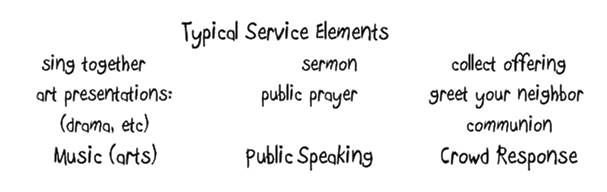
He stepped over and wrote “Typical Service Elements” on the top of a flipchart. Then he waited.

“Do you mean stuff like what songs we sing--like sermons or contemporary music? Or are you asking about things like taking an offering?” Randall asked.

“Yeah, sort of,” Jacob answered, picking up the blue marker again. “We don’t need to name the particular songs or even the style of the music for our purposes. But I am going to write down ‘sing together’ and ‘collect offering’ on here.”

“You mean the service elements,” Drew offered.

“Yep,” Jacob confirmed.

“Okay, well another obvious element is the sermon,” Drew added.

“Great,” Jacob said, writing ‘sermon’ on the flip chart. “What are other elements?”

“There’s prayer,” Jessica said.

Jacob nodded and wrote ‘group prayer’ on the page. “Several different approaches to prayer can be found in a service, depending on your denominational tradition, but it’s definitely a regular part.”

“Some churches perform dramatic skits,” Laura ventured.

“And I’ve seen dancing, both on and off the stage,” Randall said with a smile.

“Announcements,” Drew added.

“We used to turn and shake hands with other people,” Laura said. “I don’t know what you call that part.”

Jacob was rapidly writing it all down. “Let’s call those ‘art presentations (drama, etc)’ ‘announcements’ and ‘greet your neighbor’. What else?” he probed.

“How about communion?” Randall proposed.

“Of course,” Jacob said as he added that to his growing list. “Anything else?”

No one spoke up. Randall shook his head no. Drew just waited, curious where Jacob was headed. This was really obvious, so far.

He had compiled the list on the top of the big, white page:


“That’s a good list,” Jacob said. “It’s pretty much the same list I created when I was hunting for answers on what the church was supposed to look like versus what was typically done. And when I looked at these service elements, I realized two things.

“First, the differences from one typical church to another are very small. They disagree over what kind of songs to sing, but not that songs should be sung—or even that songs should come at the beginning of the service.”

“Wouldn’t that mean these elements are the right elements? I mean, if everyone is doing them, doesn’t that say something?” Drew couldn’t help asking.

“Not necessarily,” Jacob asserted. “In the dark ages the whole of Europe followed some pretty unbiblical practices. Since everyone was doing it, no one even considered other options. Just because everyone had a similar viewpoint at that time in history doesn’t mean it was God’s viewpoint. Whole generations of Israelites forgot the Law God gave to them and whole centuries of Christians throughout history missed the mark on some topics. If they were vulnerable to culture-wide blind spots what makes us think we aren’t?”

There wasn’t really a good answer to that and Drew knew enough to keep silent.

Jacob continued. “The second thing I noticed when I looked at the elements of a typical church service was a theme to the structure. The typical Western church service, as I see it,” Jacob said, gesturing roundly, “is structured around one basic concept. An elite few stand on a stage and offer performances to inspire the members to greater godliness while the members sit in rows of seats facing the stage and passively participate.”

Drew interrupted again. “Many people don’t think of it as a stage—certainly not like an entertainment stage. I think you’re misrepresenting many typical churches by using that term.”

“True, they usually give it a different name than a stage, but functionally, it’s the same thing. It’s a raised platform allowing a large group to easily see and hear what a few performers are doing. Can you bear with me on this for a minute? I think it brings a little more clarity to talk about this without the semi-theological terms that we give to our church elements, like calling the stage the altar or the podium the pulpit.”

He directed his comments to Drew, so Drew nodded, though a little grudgingly.

“In a typical church,” Jacob continued, “I see three categories of activities.”

He turned back to the flipchart and wrote while he talked:

“The first category is music and arts presentations—with the bulk of that time dedicated to singing together. Second is the public speaking category. Certainly, this means the sermon, but if you think about it, even the praying usually works more like public presentations than private prayer time. The third category I call the crowd response. Depending on the denomination, the leaders on the stage call the congregation to respond as a crowd in various ways, such as taking communion or giving an offering. And, of course, there’s the thirty-seconds-to-greet-someone-near-you portion.”

He stepped back to look at the list. “These practices are what I call the assumed elements of the typical church service.”


Jacob turned to face the rest of them and began pacing in his excitement.

“Different denominations change the frequency and placement of the crowd responses, but the music almost always precedes the sermon. Usually they spend close to 50% of the total service time singing together, roughly 45% of the time dedicated to the public speaking, including the sermon and the arts presentations. Often, the arts serve as illustrations to the sermon, so they sometimes function as one whole section. That leaves something like 5% of the service for the congregation to shake hands, put money in some type of container, and maybe take communion together. In the end, the typical church elements come down to this: music, public speaking, and a small amount of crowd response.

“The typical strategy for delivering these experiences is for the professional few to get on the stage and inspire the passive many who are seated in rows. The leaders on the stage do the work and members watch and are asked to do very little. This combination of elements and methods has been widely used for so long no one thinks about whether this is the right plan or not. People debate and explore how to execute this model better, but not about the model itself. I think it’s time to reconsider which elements should be included as well our methods for delivering them. As a mentor of mine has often said, ‘We don’t get any points for doing the wrong things well.’”

Wednesday, June 20, 2012

Your Space Matters--How To Try Something Other Than The Modernized Cathedral Layout You're Using


The space you meet in matters.

The first major breakthrough on the journey to starting my first member-driven church happened at an all-day pastor's conference. It was a gorgeous--and very large--church with:
3,000 seats, including a balcony
Not pews, but stadium seats--plush cushions, with wood armrests that sprang up when you stood up
Dark hardwood stage with a three level choir section arrayed behind the pulpit
Even what must have been a 20 foot waterfall flowing down glass (etched with the church logo, of course) on the wall above the choir seats and directly behind the pulpit

No, my insight wasn't about the grandeur or the cost. I actually grew up in some of the largest, most opulent churches in America (including a world-ranked pipe organ and stained glass)--nothing new there for me. Here's what happened...

On a break, I was being introduced to another pastor who was sitting nearby--and it was physically uncomfortable to turn to the side to talk to him. The armrests were cutting into my side. My seat was very comfortable--as long as I faced straight at the stage. So I had to stand up, and then felt a little awkward being one of the few people standing...and while we were talking, I realized this impressive church design actually discouraged building relationships with anyone around you.

Maximizing the space for one purpose means giving up some functionality in other areas. What's your space designed to do best?

Catholic and Anglican churches are often designed for the congregation that will sit, kneel, stand, kneel, sit…if you're from these "high liturgy" traditions, you know what I'm talking about.

Protestant churches are often designed to cram as many people as possible in front of a pulpit--no moving around allowed.

Pentecostal/Charismatic churches often have more room between the seats and wide aisles to accommodate dancing, falling down, etc.

But all these spaces are centered around the stage. These differences are simply nuances around this basic layout: people sit in rows facing the raised stage where the "experts" put on inspirational shows (music, talks, public prayer, etc). The space establishes two clear classes of people (on stage and off). It discourages relating to others (some even have stadium seating so the people in front of you "won't get in your way" while you're watching the stage--the important stuff. And the space often is designed to inspire awe and majesty. This isn't a bad thing. In fact, none of these features are bad. But most people aren't thinking about it purposefully. It just remains in the "well, we've always done it that way" category.

In contrast, our member-driven church space is designed to maximize the conversations and interactions between others. We use tables with chairs around them to sit at and do bible studies around. There is no raised stage and no pulpit. I either walk around when teaching or sit in a chair in a teaching circle and talk from a seated position. We make open circles of chairs for open ministry time or multiple circles--or put people around tables. We change up the arrangement from time to time so people don't get stuck in their "usual" spot, interacting only with the people sitting nearby in their "usual" spots.

Businesses spend millions of dollars designing work spaces to encourage collaboration, or creativity, to impress seriousness or playfulness. Whole school systems (e.g. Montessori) put the layout of the room at the core of their approach to child development. Interior Design was an $11 billion industry in 2011. That's a lot of people making a serious investment in the space they use.

When's the last time your church took a serious look at your interior design (and I don't mean last year's fight over the new carpet color)? If you're a typical church, you're probably using a design crafted in the middle ages--with better seats, carpets, and projection screens added to either side of the stage, of course. See the pictures of church sanctuaries throughout the years. We haven't changed the basic layout since they started building cathedrals. (If anything, our space design looks like churches are making a bigger and bigger deal out of the stage.)

What changes do you want to make in your church culture? What changes to the room layout on Sunday could reinforce that change and/or discourage the old way? Oh, and you don't even need to preach a sermon about this. Just make the change and see what moving the furniture around can do all by itself.

 
Couple of quick thoughts on room layout/space design:

Eye contact has a big impact. What's everyone looking at?  That's been elevated to the most important element of the room. Is it each other? The stage? The screens? Move the seats so people's natural gaze falls on what you want to emphasize.

Get comfortable seats. The mind can only handle as much as your bottom can endure. Get flexible seats. Don't underestimate the impact of bolted down pews for reinforcing an inflexible culture.

Break the barrier between the stage and audience. Maybe you've got a built in stage. You're not stuck with it's two-class implications. Put seating on the stage and move the pulpit to the floor. Have people cross onto and off the stage during the service (add stairs if you need to). 

Check out my previous post from my visit to SCAD for a great example of how even the most traditional of spaces (including pews) can be rearranged for an amazing effect.

Sunday, June 17, 2012

Why Men Aren't Coming To Your Church--Or Are Bored When They Do (And How Most Father's Day Services Make It Worse)


    It's a sad fact that men are much less involved in church. Some examples...

    • The typical U.S. Congregation draws an adult crowd that’s 61% female, 39% male. This gender gap shows up in all age categories. [1]
    • On any given Sunday there are 13 million more adult women than men in America’s churches. [2]
    • This Sunday almost 25 percent of married, churchgoing women will worship without their husbands. [3]
    • Midweek activities often draw 70 to 80 percent female participants. [4]
    • The majority of church employees are women (except for ordained clergy, who are overwhelmingly male). [5]
    • Over 70 percent of the boys who are being raised in church will abandon it during their teens and twenties. Many of these boys will never return. [6]
    • More than 90 percent of American men believe in God, and five out of six call themselves Christians. But only one out of six attend church on a given Sunday. The average man accepts the reality of Jesus Christ, but fails to see any value in going to church. [7]
    • Churches overseas report gender gaps of up to 9 women for every adult man in attendance. [8]
    • Christian universities are becoming convents. The typical Christian college in the U.S. enrolls almost 2 women for every 1 man. [9]
    • Fewer than 10% of U.S. churches are able to establish or maintain a vibrant men’s ministry. [10]

    Pasted from <http://churchformen.com/men-and-church/where-are-the-men/> Footnotes for these citations found there. Sources include US Census Data, Barna Reports, and that author's personal surveys at pastoral conferences.

    This probably isn't news to you.

    Why are men less involved? Is it that men are just inherently less spiritually mature? There's no biblical evidence for that.

    Do we have an anti-Jesus male culture (as almost all of the articles on this topic claim)? Sure. But women have their own anti-Christian cultural influences, too.

    My take on why men don't get involved: It's because typical church is designed to be a passive, emotional experience. We ask our men to come, sit quietly, sing love songs to Jesus--with lyrics about how safe he makes us feel, by the way--and let someone do all the work. This is the opposite of what God wired in the nature of men.

    Men want to be active--to test themselves to see if they have what it takes. Think about how little boys play versus little girls. The girls sit in corners and make their dollies have conversations--for hours. Boys get up and move around, throwing things, poking things, building things, smashing what they just built. Does typical church sound more like how girls play or boys play?

    Also, men want to sing about power and conflict overcome, not safety and the beauty of Jesus' face. Yes, we do love Jesus, and yes, once in a blue moon I need to feel safe. But safety doesn't inspire me to do something with my life. What calls to men is facing danger for a grand cause. Think about the movies that inspire men the most--it's all up to the hero, who must step up and pay the price to challenge the villain. There's a lot of running, fighting, chasing--moving. Women often find all that moving around without talking boring. They watch movies about people who don't get along and in the end realize they love each other. Those characters sit around and have conversations--and end with a kiss.

    Yes, I'm generalizing and there's a lot of exceptions to this. But these distinctions are true for huge portions of people in all cultures in the world. Again, what does typical church sound more like to you--a men's movie or a women's movie?

    However, when you give men something to do--an active, critical role to play in the service--they step up. When every Sunday they get to share their thoughts and challenge someone else's thoughts--like we do in the member-driven church--when they get to be on the team and not just a dressed up spectator--men engage. When they get to decide how much of their money goes to whom; when they get to choose how to minister during the week, even starting their own project if they want; when they get to bring some form of ministry at least every other week--when men are honored as needed doers and leaders, they engage at a level I've never seen in a typical church.

    We don't have a gap between men and women coming and in seven years of leading member-driven churches, I've never seen a gender gap.

    Most Father's Day services in typical churches, in an attempt to get men more involved, inadvertently reinforce the tragic trend. They do things like put a handful of lazy-boy recliners in the front and relieve their men of the few duties they do have on Sunday. They make Father's Day about doing nothing and spectating.

    No man wants to be a part of an organization where he doesn't play a crucial role--where he doesn't get to be active. Let them engage each other. Let them have some healthy dialogue and conflict. Don't be afraid of the conflict. Just teach them how to handle that well. Stop trying to get them to be more like women and let them love Jesus in an active way.

    Oh, and add some fierce, spiritual warfare songs in there, too.

Wednesday, June 13, 2012

Women As Ministry Leaders & The Member-Driven Church--Making A Centuries Old Controversy A Moot Point


From Awake From Atrophy (Jessica & Drew are married, visiting Jacob's member-driven church):

Jessica swallowed and quickly prayed for wisdom and courage. She hated confrontation, but she really had to ask. “You mentioned that you have women on your elder team. That brings up a question I’ve had for a little while. What do you believe about women in church leadership? How does that fit within the member-driven church model?”

Jessica didn’t realize she was holding her breath until Jacob began to answer and she released it. The question of women in ministry leadership roles had sparked many painful conversations in her years of growing up in the church, and for obvious personal reasons, was important to her. She was ready for him to wince, or look uncomfortable. Most pastors didn't like that question.

But Jacob didn’t blink—didn’t even hesitate.

“We encourage women to step up and lead in our church, if they're mature enough. But, honestly, the typical debate on this subject is kind of a moot point for us.” Jacob sort of shrugged. “It just isn’t an issue in the member-driven church. I think the controversy around women as ministry leaders is a product of two things: First, the typical structure--that was established in the medieval centuries skews what leadership means. Second, most people misread the context of the scripture passages on women in church leadership. Once we chose our model and saw the cultural background behind those passages, the question just went away for us.”

Jessica tilted her head to the side and raised her eyebrows. She’d heard many answers to this question, but never that it was irrelevant.

Jacob must have seen her confusion. “Let me explain. It all comes down to which leadership roles are restricted and which are not. Almost no one has a problem with women in some types of leadership roles, like leading a children’s ministry, for example. It’s the preaching woman, or the woman as an elder, that people argue over. But when you think about the member-driven church and what we ask all our members to do, it doesn’t make sense to be concerned about a woman leading. I don’t know any church that I’d respect who would prevent women from sharing biblical insight with other members in a conversation, or stop women from praying with people in need, or keep them from collecting money for needs. No one is really arguing over whether women are allowed to minister directly to other members. People argue over who gets to be the preacher on the stage.

“Without the pulpit dominating every other ministry, we don’t have a power struggle over who stands on stage. If you really want, I could talk more about how we interpret the verses in the New Testament where Paul places restrictions on the behavior of women during church gatherings, such as 1 Corinthians 14:34-35 and 1 Timothy 2:11-15. For me, the bottom line is this. Close study of each of these passages reveals that every time Paul restricts women’s behavior, he is citing a local law or local cultural controversy.

"For example, in 1 Corinthians 14:34-35 Paul says, "The women are to keep silent in the churches; for they are not permitted to speak, but are to subject themselves, just as the Law also says. If they desire to learn anything, let them ask their own husbands at home; for it is improper for a woman to speak in church."

"For years I read that passage and just assumed that the law Paul was talking about was the Old Testament Law--God's Law. One day I decide to validate that assumption and found there was no such Law established by God. Most Bibles today capitalize the "L", reinforcing that assumption. But the law that Paul is referencing would have to be a law of the city of Corinth.

"In short, this passage turns out to be about finding a way to honor local laws--a common theme for Paul.

Drew opened his mouth to speak, but Jacob continued, "He also says plainly that in Christ there is no male or female. Add to that the clear historical passages of women leaders in the church, including those listed as New Testament church Elders, and we don’t have any problem with women serving as Elders in their own right. Sure, Paul charges husbands and wives to submit to each other, with the husband as the servant-leader of his family. But the family dynamic is really an entirely different issue.

“Basically, the women-as-leaders discussion just isn’t a big deal to us. It’s kind of silly to think that women shouldn’t engage other members in a way that positively influences them in our church. We don’t make a big deal about a preacher and don't have a pulpit, so we don’t argue over whether women can be the preacher. Our model tries to imitate the early church. That might explain why the Bible seems to contradict itself on the question of women preachers. Culturally, it wouldn’t have been a real factor in the church life of people in New Testament times, either. Women Elders are named in the Bible, sure. But the ‘problem’ of women preachers dominating a stage each week wouldn’t have occurred to them because no one dominated the stage each week.”

“But the Bible does have something to say about women not being teachers of men, doesn’t it?” Jessica had to ask.

“It’s 1 Timothy 2:11-15,” Drew offered. He and Jessica had discussed these passages more than once and he was eager to hear Jacob’s explanation.

“Yes, I know that passage. This passage on women, in my opinion, is the most complex to understand. It talks about Adam and Eve and who was and wasn’t deceived in the fall of man. I will say that instead of making Adam look better than Eve, I think that passage is mostly a sad indictment of Adam. While Eve sinned, she was deceived. She believed she was doing the right thing. Adam, who was not deceived, knew he was doing was wrong and did it anyway.”

“I know some people who wouldn’t agree with your position, even if they believed the rest of the member-driven church principles,” Drew declared.

“Drew,” Jessica shot him a disapproving look.

“Well, I’m not saying that we disagree,” Drew half-apologized, “I’m just saying some people will disagree.”

“I do realize that,” Jacob acknowledged. “You don’t have to believe what I do concerning women in ministry to agree with the member-driven church model, though. You could implement the rest of the model and exclude women from your elder team. We don’t. But you could have male elders only, if you felt compelled to, and still run your services the way we do.”

“Thanks for explaining that,” Jessica said.

“Yeah, thanks,” Drew said. "I didn't realize how much of that argument was tied up in modern assumptions about the elements of the service."

Friday, June 8, 2012

It's Time To Finish The Great Reformation


The Great Reformation changed the world for the good in the 1500’s. Today, both Protestants and Catholics acknowledge there was a huge need for change. But its improvements were largely confined to doctrinal practices.

There were massive problems with the doctrine of that era and their thinking desperately needed to be reformed—to return to a biblical foundation. While many of the leaders of the Reformation called us to continually rethink and reform, we pretty much quit after they died. And what they changed didn't go much past the sermon content. They didn’t examine the church practices of their day much at all. Yes, some of the most glaring church practices were stopped, like the selling of indulgences, where people could buy the “right” to sin. But the Protestant church that emerged from that historical turmoil carried with it a structure and strategy that was very similar to the culturally compromised church it had broken away from.

They kept the same buildings; kept the same service order; kept the same financial model (tithing); kept  the same staffing model. They improved the teaching content and kept in housed within the medieval model of church.

And that medieval model of church solidified in an era when being clergy meant being one of the elite who could actually read. The educated few stood in front of the ignorant many and explained the scriptures to them. It was a church model shaped by the cultural forces of its time, not through serious study of the scripture.

I'm glad they started the Reformation. I'm so grateful they were courageous enough to call for sound doctrine. But I'm sad over 500 years later we're still stuck where they started. It’s time to finish the Reformation and return not just our beliefs but also our behavior to a radically biblical foundation.